Safe Home Elevators for Senior Citizens: Comfort & Access
India has a fall problem that most families don’t talk about until it happens. Studies across the country put stair-related fall prevalence among elderly adults between 26% and 37%—and among those who fall, more than half sustain injuries, with 23% reporting lasting disability afterward. Stairs are the most common fall site inside homes, accounting for a disproportionate share of hip fractures, wrist injuries, and spinal damage in people over 60.
The solution isn’t a walking aid or a railing upgrade. It’s removing the stair trip entirely. A home elevator gives your elderly parent the ability to move between floors independently, without asking for help, without gripping a banister and hoping for the best.
This guide covers why elevators outperform stairlifts for senior safety, the specific features that matter, lift types that suit Indian homes, installation realities, and what ongoing maintenance looks like.
Why Home Elevators for Seniors
Falls don’t discriminate by income or home size. They happen in well-furnished apartments and modest bungalows alike, on well-lit staircases with proper handrails. The risk rises sharply after 80—older adults in that group fall at 1.5 times the rate of those aged 60-69.
Here’s what most families don’t factor in: 71% of seniors globally prefer staying in their own home over moving to assisted living, regardless of mobility limitations. A home elevator supports that preference with engineering rather than willpower.
Beyond the user, it reduces caregiver fatigue. When a parent can move independently between floors, family members stop organizing their schedules around stair assistance.
Essential Safety Features
Not all elevator safety features hold equal value for elderly users. These are the ones that move the needle:
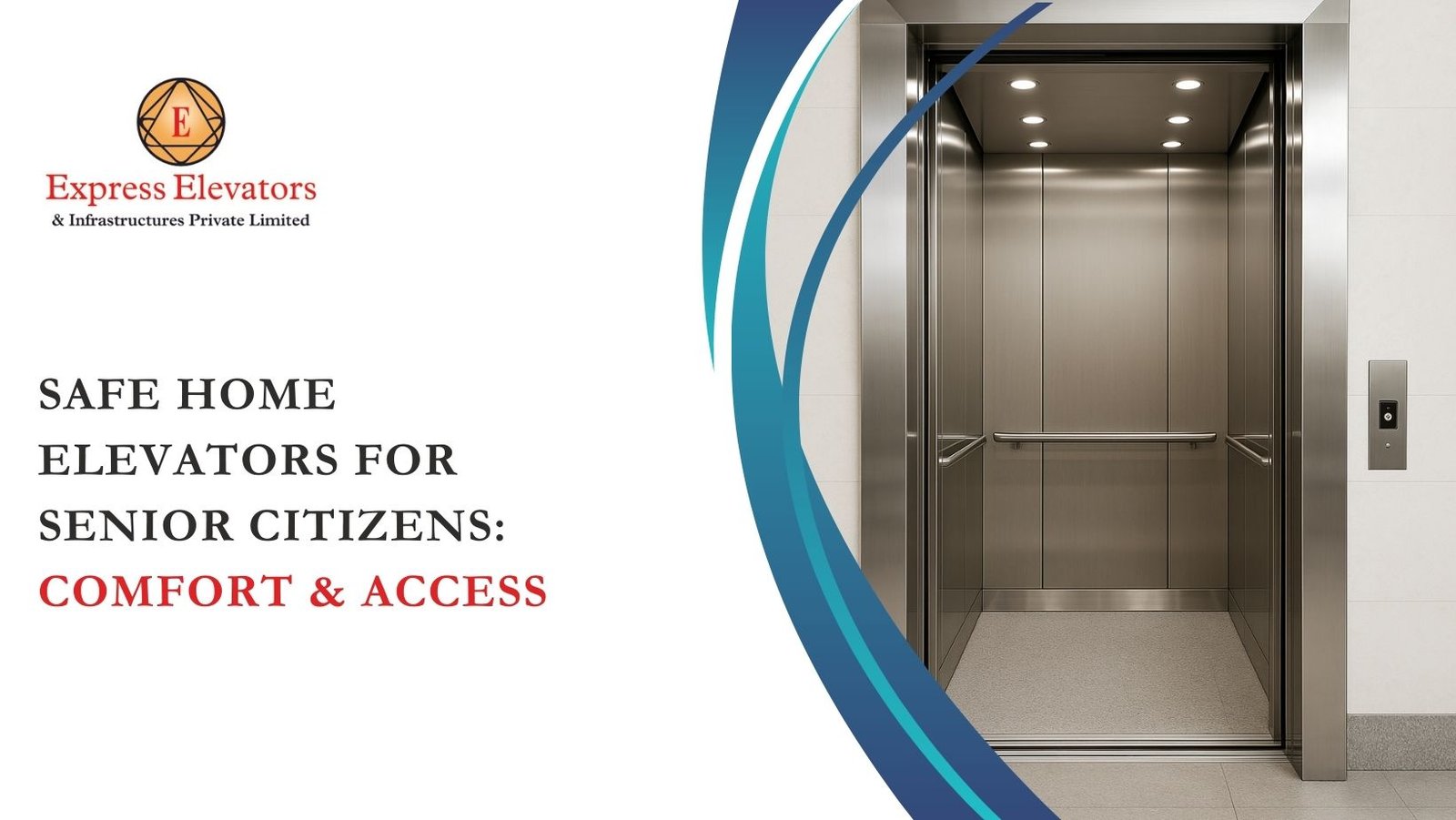
- Automatic door sensors: Detect obstructions without physical contact, preventing doors from closing on canes, walkers, or slow-moving limbs
- Emergency stop and intercom: Clearly marked, large-button controls with two-way voice communication to call for help without a mobile phone
- Battery backup/ARD: During power cuts, the cabin descends automatically to the ground floor and opens—no entrapment risk, no waiting for technicians
- Smooth start/stop mechanism: Gradual acceleration eliminates sudden jolts that throw off balance in elderly users with vertigo or joint conditions
- Overload sensor: Stops operation if weight exceeds rated capacity, preventing mechanical stress that causes unpredictable behavior
- Safety governor: Activates braking automatically if cable failure or freefall speed is detected
Non-slip flooring inside the cabin cuts fall risk by 65% compared to smooth surfaces, according to industry safety studies. This is a specification to confirm—not assume—when buying.
Accessibility Design Elements
Cabin and Door Sizing
The entry threshold should sit flush with the floor landing, within ±5mm tolerance. A bump—even a 10mm step—creates a trip hazard for someone using a walker. Insist on this specification during commissioning, not just during the sales pitch.
Door width of 900mm or more allows wheelchair access with room to maneuver. Standard 800mm doors accommodate most walkers and rollators but create tight clearance for powered wheelchairs. If mobility requirements are likely to change, specify wider doors upfront.
Interior Usability
- Bright LED lighting (minimum 300 lux) eliminates the visual adaptation delay that causes missteps when entering from a darker corridor
- Grab bars on at least two walls at 800-900mm height give support during the slight sway at start/stop
- Large, backlit control buttons with tactile markings accommodate failing eyesight and reduced hand strength
- Fold-down seat inside the cabin lets users sit during longer travel on multi-story homes
- Keyed call controls prevent unsupervised use by young children who might ride alone
Elevator Types for Elderly
Hydraulic and Traction Options
Hydraulic home lifts run quietly, carry 340-450 kg, and accommodate wheelchairs easily. They need a pit and machine room but offer the smoothest ride of any drive type—important for seniors with balance sensitivity. Cost: ₹6-14 lakh for the unit.
Gearless traction MRL elevators eliminate the machine room, reducing installation disruption in existing homes. They run at 0.5-1.0 m/s and handle heavier use patterns for families where multiple members also use the lift.
Stairlift vs Full Elevator
Stairlifts cost less upfront—₹2-5 lakh—but require the user to transfer from a wheelchair or walker to the stairlift seat, then transfer back. For seniors with hip replacements or limited upper body strength, that transfer is itself a fall risk.
A full elevator requires no transfer. The user enters in whatever mobility aid they use, travels, and exits without repositioning. The upfront cost difference closes considerably when you account for this functional gap.
Installation Considerations
Site surveys must confirm: floor-to-floor height, available footprint, load-bearing capacity of existing floors, and electrical supply adequacy. Retrofits in occupied homes need phased work to minimize disruption—evening or weekend installation schedules, dust barriers, and protected access routes for elderly residents during the process.
Compliance with IS 14665 standards, ARD certification, and state lift inspection requirements apply regardless of whether the elevator is for personal or shared use. Confirm that your supplier handles documentation rather than leaving it to you.
Maintenance for Long-Term Safety
A home elevator serving elderly users needs quarterly preventive checks minimum—monthly if daily usage exceeds 10 trips. Safety devices deteriorate silently: door sensors drift out of calibration, ARD batteries lose capacity, grab bar mounts loosen over time.
AMC contracts for senior-focused installations should explicitly include safety device testing at every visit, not just lubrication and general operation checks. Ask for a written checklist of what each service covers.
Response time for breakdowns matters more when elderly users depend on the lift for daily mobility. A 24-hour response SLA that works for a commercial building is inadequate for a home where the alternative is stairs.
Cost Overview
Equipment for a standard senior-friendly home elevator runs ₹6-18 lakh depending on type, capacity, and safety features. Installation adds ₹1.5-5 lakh for standard retrofits. Safety add-ons—grab bars, fold-down seats, keyed access, emergency communicator—cost ₹40,000-1.2 lakh on top of base specs.
State governments and housing societies in some areas offer GST benefits or partial subsidies for senior and disability-focused mobility installations. Check applicable schemes before finalizing your budget—these aren’t widely advertised but do exist.
Annual AMC runs ₹25,000-75,000 for comprehensive coverage including safety device testing, parts replacement, and emergency response.
Choosing the Right Lift
Match the specification to current and likely future mobility status:
- Walker/cane user: Standard 900mm door, smooth hydraulic or traction drive, grab bars, non-slip floor
- Manual wheelchair user: 1000mm+ door width, 340 kg minimum capacity, flush threshold, fold-down seat optional
- Powered wheelchair user: 1100mm door, 450 kg capacity, wider cabin at 1100mm x 1400mm minimum
- Two users simultaneously (parent + carer): Size for 4-person capacity regardless of typical usage
Future-proofing matters. A parent currently mobile on stairs may need wheelchair accommodation in 3-5 years. Specifying a wider door and higher capacity now costs less than retrofitting later.
FAQs
Can a senior use the elevator unsupervised safely?
Yes, with keyed call controls that restrict access to authorized users and emergency intercom for two-way communication with family members. Properly specified home elevators are designed for solo elderly use—that’s their primary function.
What happens if the power cuts while an elderly person is inside?
Battery backup ARD brings the cabin to the nearest floor, levels it within ±5mm, and opens the doors automatically. No manual intervention required. The passenger exits normally, as if the trip had completed.
Are home elevators eligible for any tax benefits in India?
Some state government schemes and housing society grants partially cover mobility installation costs for senior citizens. GST benefits may apply in certain configurations. Check with your builder association or civic body before purchase.
How long does retrofit installation take in an occupied home?
Standard retrofits take 3-6 weeks depending on drive type and shaft requirements. Pitless and shaftless configurations install in 3-5 days with minimal structural work—better suited to homes where the elderly resident needs continuous access.
Express Elevators designs and installs home elevators specifically configured for senior safety—proper thresholds, safety-certified grab bars, emergency intercoms, ARD backup, and smooth-ride drives that accommodate balance-sensitive users. We cover supply, installation, and AMC across India, with response times that reflect the urgency of a mobility-dependent household. Our site assessment identifies the right specification for your parent’s current and future mobility needs, not just what’s easiest to install.
Planning a home elevator for an elderly family member? Contact Express Elevators for a free site assessment and specification consultation. We’ll give you a clear breakdown of what’s needed, what it costs, and how long installation takes—before you commit to anything.