
Top Hospital Elevator Supplier in Chennai
Hospital administrators in Chennai face a problem most don’t talk about: elevator downtime costs ₹6,25,000 per minute when you factor in delayed surgeries, postponed imaging procedures, and operational disruptions. Yet procurement teams still select suppliers based on lowest quote rather than uptime track record.
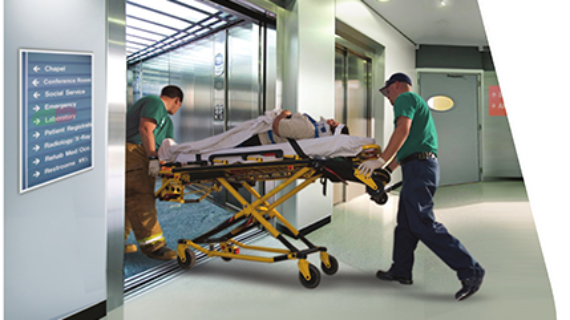
A hospital elevator isn’t interchangeable with commercial passenger lifts. You need 1600mm x 2400mm cabin space to fit a standard bed plus two attendants. Door openings must accommodate stretchers entering at angles during emergencies. Antibacterial surfaces matter because high-touch elevator buttons become infection vectors. And when the lift stops working at 2 AM, you need a supplier who stocks spares locally and responds within hours, not someone who promises service “soon”.
This guide covers what separates hospital elevators from standard lifts, core design requirements, infection-control features, performance specifications, supplier evaluation criteria for Chennai, installation in live hospital environments, and maintenance realities that affect patient care.
What Makes Hospital Elevators Different
Hospital lifts handle three distinct traffic types: bed/stretcher movement for patient transfers, staff circulation between departments, and service/supply transport for meals, laundry, and medical equipment. Each creates different loading patterns and usage intensity compared to office buildings.
The elevator must accommodate a 2100mm hospital bed, two medical staff, IV stands, and monitoring equipment—all while maintaining ride smoothness that doesn’t disturb critical patients. Standard passenger lifts with 1000mm x 1100mm cabins physically can’t do this.
Elevator Categories for Hospitals
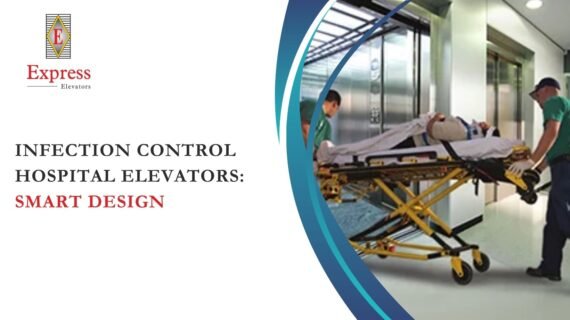
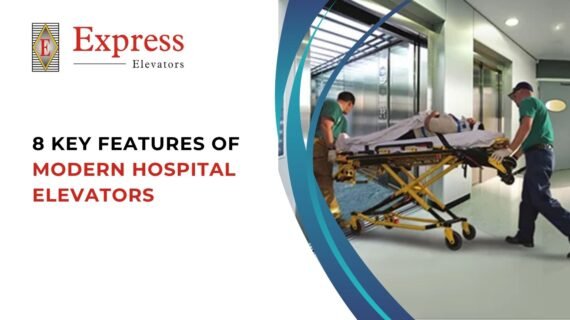
Stretcher lifts use 1600mm x 2400mm cabins with 1000-1600 kg capacity and run at 0.4-1.5 m/s depending on building height. These serve emergency departments and ICUs where speed matters.
Bed elevators handle full-size hospital beds and require 2500 kg capacity for equipment-heavy patient transport between surgery and recovery floors. Service lifts move supplies and waste with separate circulation to prevent cross-contamination with patient areas.
Core Design Requirements
Cabin and Door Specifications
Minimum internal cabin dimensions for stretcher transport: 1600mm width x 2400mm depth. This allows attendants to stand at the head and foot of the stretcher during transit. Anything smaller forces awkward diagonal loading that delays emergency response.
Door width must be 1100-1400mm with center-opening configuration. Side-opening doors create tight entry angles. Center-opening provides clear, straight access that matters when seconds count.
Leveling accuracy within ±5mm prevents the bump that jolts patients as the stretcher rolls in. Poor leveling also creates trip hazards for staff pushing heavy equipment.
Priority and Emergency Controls
Independent service mode lets staff recall the elevator to a specific floor and hold it there during emergencies, bypassing all other calls. Without this, the lift responds to every button press and wastes time stopping at floors that don’t need it.
Emergency communication systems must connect directly to the hospital’s central monitoring station, not an external call center that doesn’t understand medical facility protocols.
Infection Control Features
Here’s what procurement teams miss: elevator cabins are high-touch environments that hundreds of people contact daily. Standard painted MS cabins with grooves and joints trap contaminants.
Antibacterial Surfaces and Materials
Stainless steel walls with antimicrobial nano-coatings reduce bacterial load by 60-80% compared to untreated surfaces. The coating disrupts microbial cell walls on contact, providing continuous protection without requiring constant cleaning.
Seamless cabin construction eliminates joints where fluids accumulate. Coving (rounded corners) between walls and floors prevents dirt buildup and makes sanitizing faster.
Control panels should mount at heights accessible to wheelchair users and use touchless sensors where possible. Lower-mounted buttons with large tactile surfaces reduce the need to touch shared surfaces repeatedly.
Performance Specifications
Load capacity for hospital elevators ranges from 1000 kg (basic stretcher lift) to 2500 kg (full bed elevator with equipment). Undersizing this creates dangerous situations where staff must choose between sending adequate medical personnel with the patient or staying below weight limits.
Speed requirements depend on building configuration. For 3-5 floor hospitals, 0.5-1.0 m/s handles traffic adequately. Multi-story facilities with 8+ floors need 1.5-2.0 m/s to prevent bottlenecks during shift changes when 200+ staff members move simultaneously.
Noise levels matter more in hospitals than commercial buildings. The lift motor, door operation, and travel noise should stay below 55 decibels to avoid disturbing patient floors. Standard hydraulic systems generate 60-70 decibels—acceptable in offices, disruptive near ICUs.
Supplier Evaluation for Chennai
Local service presence in Chennai determines whether a breakdown gets fixed in 2 hours or 2 days. Ask suppliers for their Chennai service center address and spare parts inventory location. If they route service calls through a regional hub in Bangalore, response times triple.
Check hospital references specifically—not just any elevator installation. Hospital environments create unique stress: 24/7 operation, heavy loads, frequent door cycles, and zero tolerance for extended downtime.
Ask for documentation showing past projects: hospital name, number of units installed, years in operation, and current service status. Vague claims about “serving the healthcare sector” mean nothing without verifiable references.
Quote Transparency
Hospital elevator quotes should separately itemize equipment cost, installation labor, shaft preparation (if needed), safety feature testing, infection-control coating specifications, and commissioning. Bundled quotes hide costs that appear later as “necessary upgrades.”
Clarify who handles coordination with hospital infection control teams during installation. Some suppliers assume the hospital manages dust barriers, work-hour restrictions, and sterile zone protocols. Others include this coordination as part of project management.
Installation in Live Hospitals
New hospital construction allows standard 5-6 week installation timelines. Retrofits in operating facilities require night-shift work, infection-safe barriers, and phased commissioning that doesn’t disrupt patient care.
Site surveys must assess not just shaft dimensions but also access routes for moving equipment into the building, proximity to ICU/OT areas that restrict noise, and electrical infrastructure capacity for the elevator’s power requirements.
Civil readiness means the shaft is plumb within tolerance, pit drainage works, machine room (if needed) has adequate ventilation, and hoistway doors align precisely at each floor. The elevator supplier can’t compensate for civil defects—they can only document them and refuse to commission until corrections happen.
Maintenance and AMC
Preventive maintenance for hospital elevators should happen monthly, not quarterly like commercial lifts. The usage intensity and criticality justify the added service frequency.
Comprehensive AMC contracts must explicitly include emergency spare parts, not just routine consumables. A contract that covers “all scheduled maintenance” but excludes door motors, control boards, and drive components isn’t actually comprehensive.
Response time SLAs matter more in hospitals than other buildings. A 24-hour response time that works for offices is unacceptable when elevator downtime prevents patient transport between floors. Insist on 2-4 hour response with financial penalties for violations.
FAQs
Q: What’s the typical cost for a hospital stretcher lift in Chennai?
A: Equipment starts around ₹5-8 lakh for basic 1000 kg stretcher lifts, while full bed elevators with 2500 kg capacity and antibacterial finishes run ₹12-20 lakh before installation. Installation adds ₹2-5 lakh depending on shaft readiness.
Q: Can we retrofit hospital elevators in older buildings without major construction?
A: Yes, if vertical space exists and floor loading capacity supports it. MRL (machine-room-less) configurations eliminate the need for a separate machine room, reducing structural modifications. Site surveys determine feasibility.
Q: How do antibacterial elevator surfaces actually work in reducing infections?
A: Nano-coatings use silver ions or copper compounds that disrupt bacterial cell walls on contact, reducing microbial load by 60-80% without continuous cleaning. The coating remains effective for 3-5 years before reapplication.
Q: What happens if the hospital elevator breaks down during a critical patient transfer?
A: Properly specified hospital elevators include Automatic Rescue Device (ARD) that brings the cabin to the nearest floor during power failures and opens doors automatically. This prevents entrapment. For mechanical failures, 2-4 hour service response is standard in Chennai.
Express Elevators specializes in hospital elevator solutions for Chennai’s healthcare facilities. We supply stretcher lifts and bed elevators with infection-control surfaces, priority controls, and smooth ride quality that protects patient comfort. Our Chennai service team stocks critical spare parts locally and guarantees 2-hour emergency response to minimize downtime impact on patient care.
Planning a hospital elevator installation or experiencing service issues with your current supplier? Contact Express Elevators for a detailed site assessment and uptime-focused AMC proposal. Let’s put a solution in place that treats elevator reliability as the patient care issue it actually is.